PESHAWAR: Afghanistan’s interim Taliban government has reportedly begun engaging Indian social media influencers and YouTubers to reinforce what it describes as a negative and unfounded narrative against Pakistan on digital platforms.
According to sources, amid growing ties between the Taliban government and India, Kabul has expanded its outreach beyond Indian journalists and is now using Indian YouTubers and social media influencers to promote its media narrative.
According to details, Indian digital media influencers have also been brought into a campaign aimed at distorting facts surrounding Pakistan’s “Operation Ghazab lil-Haq”, presenting a one-sided account of events, and promoting what critics describe as an unfounded narrative against Pakistan.
Sources say that several Indian influencers have been specially issued visas to Afghanistan and are being facilitated by the authorities to visit various areas along the Pakistan-Afghanistan border.
During these visits, they are reportedly being provided opportunities to produce videos and other digital content based on information supplied by government or Taliban officials. Such content is subsequently being circulated on social media platforms in support of the Taliban government’s narrative.
According to analysts, one of the objectives of this campaign is to prevent the Afghan public from receiving a balanced picture of the facts and to portray the Taliban government as a strong, influential and invincible military force.
By utilizing the extensive reach of Indian digital platforms, the Taliban government is reportedly attempting to create a favorable image in which ground realities and controversial aspects of recent events are overlooked.
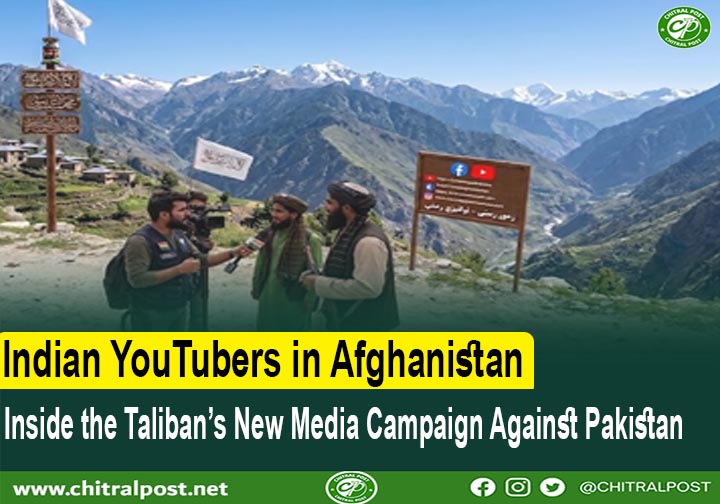
As part of this campaign, Indian YouTubers “Bishnoi” and “Harsh” were reportedly taken to various areas along the Pakistan-Afghanistan border under special arrangements.
Among them, Indian YouTuber “Bishnoi” also visited the Afghan area of Dokalam, located opposite the Chitral border town of Arandu. In a vlog produced from the area, he highlighted what was portrayed as the Taliban’s military capability and bravery, and released content based on claims described by critics as unfounded across various social media platforms.
Journalists and analysts closely monitoring Afghan affairs say that the vlog overlooked several important aspects of the border situation and past events. They questioned why incidents in which Taliban forces reportedly faced serious difficulties and pressure at the local level were not mentioned if the Taliban forces were being portrayed as so strong and invincible.
Similarly, critics say that information provided by the Taliban government to the Indian YouTubers deliberately omitted important developments in the eastern districts of Afghanistan’s Nuristan Province. According to these accounts, during a 47-day conflict, the Nuristan districts of Barg-e-Matal and Kamdesh were effectively cut off from the rest of Afghanistan.
Critics argue that ignoring such ground realities while presenting only a particular narrative indicates that the Indian YouTubers have been brought into the field for specific purposes.
Political and media circles say that the extraordinary facilities and protocol reportedly extended by the Taliban government to Indian YouTubers and influencers indicate that Kabul is increasingly relying on Indian digital platforms to project its political and media narrative internationally.
According to analysts, after the campaign against Pakistan conducted by Afghan social media activists and other channels failed to receive the desired level of public traction, Indian digital media is being given a more prominent role in the campaign.
Observers, however, point out that repeatedly promoting a particular narrative through social media does not change ground realities, and such claims should be independently verified through credible and impartial sources.
The reported contacts, conversations and filming between these Indian YouTubers and members of the Pakistani Taliban operating in Afghanistan have further fueled concerns that Pakistani Taliban militants are not only present inside Afghanistan but are also continuing their activities openly, allegedly under the patronage of Afghan authorities, while enjoying easy access to media platforms.
Critics further argue that the Taliban government’s elaborate arrangements to bring Indian YouTubers to Afghanistan and facilitate their access to members of the proscribed Fitna al-Khawarij demonstrate, in their view, the extent to which the Afghan government is willing to go in pursuing an anti-Pakistan agenda.